Abstract
This study surveyed 203 students, parents, educators, and recent graduates across North Dallas to identify the primary barriers preventing effective college preparation. Despite attending some of Texas's highest-performing school districts, North Dallas students face significant obstacles accessing quality preparation resources. The research revealed four critical barriers the people struggle with: cost of test prep services (cited by 40.9%), essay writing challenges (41.9%), information fragmentation across multiple platforms with a most common confusion rating of 7/10 when finding resources, and scholarship discovery difficulties (35.5%). Survey data demonstrated no single dominant resource exists; respondents search across YouTube (37.9%), Google (34%), school counselors (24.6%), and paid services (29.6%) with no centralized guidance. When asked what would most improve their preparation experience, all responses clustered around three needs: application timeline tools (38.4%), test prep service comparisons (37.9%), and local scholarship databases (32%). Critically, 89.1% indicated they would be interested in using a centralized platform comparing all kinds of resources, with zero respondents opposing the concept.
The findings suggest that North Dallas students possess strong academic foundations but lack the consolidated, accessible preparation support necessary to translate top-tier high school education into successful college applications. An effective solution must address cost transparency, information consolidation, essay guidance, and scholarship visibility through a universally centralized, free platform tailored to North Dallas’s regional needs.
Introduction
Despite attending some of the highest-performing school districts in Texas, many students in North Dallas continue to struggle when preparing for college. Families often have to rely on a combination of various school counselors, scattered online resources, and highly paid services to find their own preparation resources. Yet, access to a clear, affordable, and centralized guide remains unavailable. As college admissions and financial aid processes grow increasingly costly and complex, students without the ability to support a strong preparation and support may be placed at a stronger disadvantage, even though they may have strong academic backgrounds. This study examines the barriers North Dallas students and families have when they start facing the college preparation process and analyzes survey data to even better understand the bigger gaps in access, clarity, and available resources in North Dallas.
Background
The transition from high school to college learning has become an increasingly complex and confusing process in the United States. Regions like North Dallas, which houses some of the best school districts and schools across the nation, often find the inability to provide for the students' next steps in college preparedness. Their academic excellence within the classroom does not always translate as seamlessly for their students hoping to make that next step. In these communities, students and families must individually navigate conflicting and scattered advice from multiple different resources like school counselors, social media, or even online searches that may even be too costly. This lack of centralized help creates a barrier where the primary challenge lies in the inability to verify and find enough information to support good development for themselves or their child. Paired with rising costs and additional essay writing support, the journey from high school to college can become very difficult.
This systematic fragmentation when it comes to money can often force families into a high-pressure environment when deciding to pay for the resources they can find or to save costs and try to find free/low-budget resources that are already scarce. When these resources the families and students try to find are across multiple different platforms with no clear “source of truth,” the entire process becomes a secondary curriculum that students must master and try to balance on top of their existing high school academic/athletic workload. This creates a large disparity in readiness even among students in the highest-performing schools and districts. So, without a consolidated path to follow for the students, their journey to college remains a stressful and expensive endeavor that places an unnecessary strain on the household and the students' own personal development from one stage of their life to another.
Research Questions
1. What barriers most impact college preparation access for North Dallas students and families?
2. Where do students and families currently find college prep information, and how confusing is the process?
3. What free or low-cost resources do respondents say would help the most?
Research Methods
Between December 2025 and January 2026, a survey was distributed to local North Dallas region parents, students, educators, and recent high school/college graduates to assess college preparation accessibility and identify resource gaps that the community needs. The survey was dispensed through local North Dallas community groups and student/parent networks online. It was also shared with fellow classmates, teachers, friends, parents, recently graduated students, and college students from North Dallas high schools who went through the college preparation process. The study focused on regional college preparedness impediments that affected many families in the North Dallas region, as they lack centralized access to college preparation resources. Many students who have high aspirations and the academic capabilities for top universities in the nation have a disadvantage, just because they don’t have the same resources that others might, especially for those that are underserved or not as financially able. Realizing this, the data was analyzed more precisely to find the true statistics behind the problem.
They were asked about their biggest challenges, what current resources they were using, how confusing the overall process is, an estimation on how much they've spent for resources, what would make it easier for them, what scholarships they have found, etc. The survey collected 203 responses across multiple roles of different people. With 47.8% of the respondents being a parent or guardian of a student, 34% were current high school students, 16.3% were recent high school graduates, and the remaining 2% were educators and recent college graduates that went to a North Dallas high school. For the high school students that responded, 4.5% were freshmen, 26.9% were sophomores, 36.3% were juniors, and 21.4% were seniors. Showing that most respondents were current juniors, who are soon to be preparing for the college application process. Across parents, students, recent graduates, and educators, 35.5% are located in the McKinney area, 30% in Plano, 18.2% in Frisco, and 14.3% in Allen, while the rest are in other nearby North Dallas areas.
Data
Cost Barrier
The cost of preparation emerged as one of the single largest barriers to accessing quality college prep resources. Survey data revealed that 31% answered that they have spent over \$500 in resources (with 11.3% saying they have spent over \$1000), while the largest group reported spending between \$100 and \$500 (36.5%), with only 5.4% stating they have spent \$0 on college prep services.
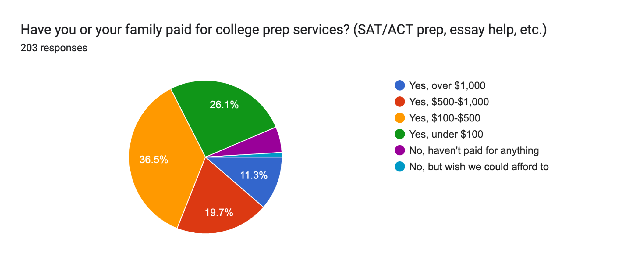
Figure 1. Paid College Prep Services
Figure 1 illustrates the significant financial disparity, which creates an unfair playing field for less fortunate families who wish they could get the same preparation and readiness that other more fortunate families might get. This can make certain students go without these services completely or try to sustain their budgets trying to compete. While even the ones who do get access to premium services face another problem. They don't know which programs are worth the money and are still paying amounts that nobody should have to pay, due to a limited knowledge of what exists out there or what programs their money is really worth it for.
One student, for example, even said they wanted "affordable, high-quality prep resources instead of expensive private counseling services." Families want and deserve transparent information about true out-of-pocket costs before getting tutors, programs, and services. When asked to select their #1 biggest challenge preparing for college, 40.9% cited the cost of prep resources. Following this trend, an analysis of open-ended responses reinforced this pattern: understanding college prep costs and having a wider knowledge of what's out there before they purchase are the most important things to a good preparation. Respondents expressed the need for "a trusted source to answer quick questions without having to search through conflicting information online" and "a single, easy-to-follow plan that removes guesswork from college prep." People heading into this process want these things because they are confused, paying too much, and everyone is lacking the resources they need to set themselves, students, or friends/families up for success.
Information Fragmentation
Students and parents are searching for college preparation guidance across multiple platforms with no centralized, trusted resource. Survey data confirmed this fragmentation when there was no single dominant source. The survey asked respondents in North Dallas how they found their current college prep information. Survey results indicated YouTube (37.9%), Google (34%), friends (32%), paid services (29.6%), parents (28.6%), and school counselors (24.6%). Six of the nine most popular answers were within 13.3% of each other, with the seventh most popular choice (social media) only being 7% behind school counselors.
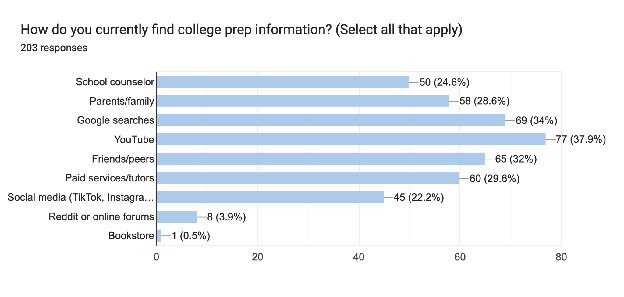
Figure 2. How Respondents Currently Find College Prep Information
The analysis demonstrates this fragmentation. This makes information extremely scattered across multiple different platforms, leaving students and parents confused on where to look for correct help, wasting time in the process that should be spent actually preparing.
Another question on the survey asked respondents to grade their overall confusion and how scattered they find college prep information on a scale of 1-10. Notably, 61.9% of respondents rated their confusion a 7/10 or higher, with 32.7% choosing 7 (the highest-rated option), 15.8% choosing 8 (second highest), 9.9% choosing 9, and 3.5% choosing 10.
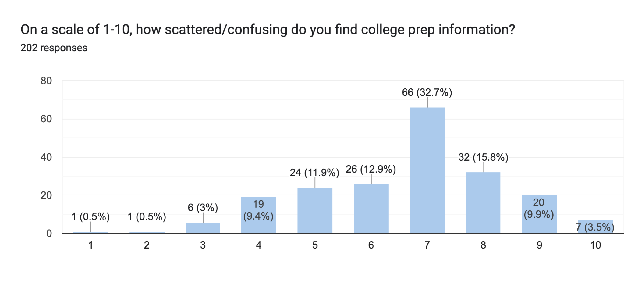
Figure 3. Rated Confusion Rates on a Scale 1-10
The respondents' answers tell us that not only is college prep info scattered, but it's also very confusing for the same reason. People are getting conflicting advice from various different sources since there isn't one dominant place to go. One response from a previous short answer question said they wanted "a trusted source to answer quick questions without having to search through conflicting information online." The evidence strongly suggests that people want "all [the] info in one place" and "having all the information in front of me, [with] no searching." This process as it stands right now remains confusing and time-consuming when preparing for college. To back this up further, when the survey asked what free or low-cost college prep resources would be the most helpful, out of 203 answers, 77 respondents said they wanted an all-in-one comparison of college prep resources. Where they find their information now isn’t helping, and it remains as one of the largest barriers, at least in the North Dallas area.
Essay Writing Challenge
Essay writing emerged as the most reported challenge, cited by 41.9% of respondents, narrowly surpassing even cost barriers (40.9%).
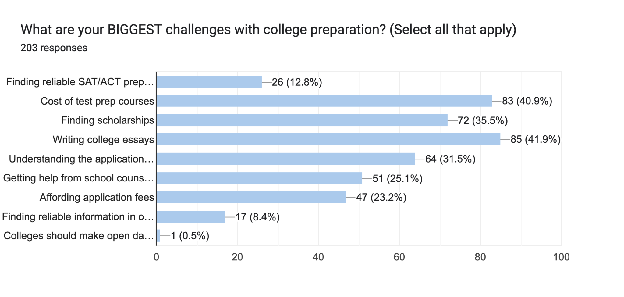
Figure 4. The Biggest Challenges in The College Prep Process
The data confirms this finding. Students need the most help when it comes to writing college essays; this may be because, unlike test prep (clear right/wrong answers), essays are subjective, so help requires even more proactive feedback and tutoring. Many students also haven't developed personal storytelling skills or writing techniques that they need for a well-done college application essay. It’s also hard to know if your essay is “good enough” when most students find their college tutoring online with no personal feedback. When answering “What free or low-cost college prep resources would be most helpful to you or your student?” More than a quarter (27.6%) of people selected “Essay Writing Resources and Examples” as their first answer choice. In two of the short answer responses, 35 people mentioned needing help on essays or what they need to make a great preparation journey in regard to essays. They realize essays can be a pivotal factor in the application process but don't know how to develop them. Various responses when the survey asked what they wished someone had explained to them earlier reported that "Essays are a chance to stand out beyond grades and scores," "Essays allow students to explain more than just grades," "Essays help admissions officers understand applicants better," and "Essays often carry more weight than expected in admissions decisions."
So they know just how much weight it can really hold. While knowing how substantial essays really are, they strongly expressed the need for help. Some answers said they need "support with writing authentic, compelling personal statements," "examples of strong essays from successful applicants," "feedback on essays before applications are submitted" (appears twice), "essay prompts explained with examples of strong responses and common mistakes to avoid," and "essay prompts because I have trouble trying to figure out if my essay is good enough." All the data reveals a critical gap: students understand that essays can determine admission outcomes, yet they lack the resources to actually get them there. This disconnect is why essay writing is the largest barrier in college preparation and reinforces the need for centralized, affordable essay resources.
Scholarships & Financial Aid
Finding scholarships emerged as the third-largest challenge, cited by 35.5% of respondents, but understanding the research process reveals why this barrier is so significant in the college preparation process. Like information fragmentation, there is no dominant source when it comes to finding scholarships. Survey responses to the question, “Have you found any scholarships through your own research? If yes, how did you find them?” Students said they can typically find some across multiple fragmented sources like school counselors, Google searches, college websites, local organizations, social media, school newsletters, and friends. However, none of these really give them specifically what they need or want based on who they are and what their background is on an individual level. More concerning, a substantial portion of respondents reported finding no scholarships at all despite active searching. Survey data revealed students said "No" when asked if they found scholarships, with one saying, "I could not find any I was eligible for." This can waste endless amounts of time for families trying to save money for college tuition once accepted.
Supporting this need, 32% of respondents also expressed the need for a local scholarship database to easily find what they want. They want "early identification of scholarships the student actually qualifies for" and "easy access to scholarship deadlines and eligibility rules." So many local scholarships go unclaimed every year because students don't know they even exist. Even beyond finding scholarships, let alone ones that they can even find, students expressed confusion about how financial aid systems work. They said, "No one explained how financial aid, FAFSA, and scholarships really work together in the application process," and "Financial aid forms and scholarship applications can be surprisingly complicated." This adds another layer of complexity on top of the already big search problem. This directly connects back to the cost barrier as described earlier. If parents have enough money to support their children's preparation, families may struggle to support the annual tuition of their child's university after.
Average in-state tuition a year is from \$11,000 to \$12,000, while out-of-state can be almost triple that. Private school tuition, on the other hand, can be up to \$45,000 a year (College Board, 2024). These costs can be very strenuous for some families, who may not be eligible or unable to find scholarships just because they may be confused about where to look and apply for ones that actually fit them and their needs. Missed scholarships represent lost funding that can determine college affordability and attendance, which can directly shape a student's future after high school.
Demand for Centralized Solutions
When asked what free or low-cost resources would be most helpful, responses clustered around three key needs that directly align with the barriers identified above. Application timeline tools (38.4%), test prep service comparisons (37.9%), and a local scholarship database (32%) are among the most needed resources that the people selected. Based on the percentages, the students know exactly what they need based on their own experiences and thoughts with college preparation. Even more telling, though, when asked directly if they would use a free website/hub comparing different college prep resources in one place, demand was overwhelming. Data showed 89.1% of the respondents indicated they would be interested in it, with 50.2% saying they would definitely use it, while only 10.8% said maybe. This strongly validates what they have been saying and the need for a centralized hub. Notably, zero respondents selected "Probably not" or "No," indicating a universal recognition of the value a free website could have for people.
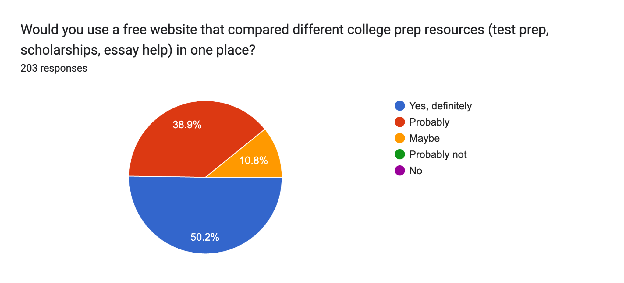
Figure 5. Respondents’ Interest in Using a Free Centralized College Preparation Resource Platform
The percentages reveal an overwhelming support for a centralized solution, with the complete absence of opposition. This demand for consolidated information and resources also appeared consistently throughout the open-ended responses as well. Multiple people expressed wanting an "all info in one place" hub. Respondents also specifically requested "one trusted guide to navigate applications, testing, and financial aid," "a trusted source to answer quick questions without having to search through conflicting information online," and "a database that has everything that I'm looking for that is easily organized and easy to read, providing me with current information." North Dallas needs easier-to-find information on one platform that is accessible to everyone to help across multiple different aspects of the college preparation process. After all, students want to spend their time preparing for college, not searching for how to prepare.
Discussion
Based on the identified barriers, an effective solution needs to address four core challenges: cost accessibility, information fragmentation, resource quality uncertainty, and personalized guidance gaps. As a whole, 64 respondents reported choosing “understanding the college process” when asked what their #1 struggle was with college preparation. When examining the data more closely, however, it's easy to understand exactly why people are so confused and struggling. Resources cost too much and are difficult to find/use, people can’t write good essays without proper access to advice and help when they need it, scholarships are being wasted because families are unaware they exist or don't know the qualifications to apply, and all people surrounded by or going into the preparation process don't have a centralized solution to help them with all their college difficulties while going through the long process. In reality, college preparation is increasingly complex and difficult to navigate without structured guidance, but it doesn't have to be this way.
Students and families deserve peace of mind knowing that their children not only are getting a good education in North Dallas but also hold readiness for their future when heading to college. Students are practically positioned for success in the area; North Dallas has amazing school districts across many different cities/areas, holding some of Texas’s best education. Coppell ISD, Allen ISD, Lovejoy ISD, Frisco ISD, Wylie ISD, Universal Academy, and Highland Park ISD all rank within the top 25 best school districts overall in the state (Niche, 2025). To name a particular instance, Dallas ISD ranked #9 nationally by U.S. News & World Report in 2025 for their School for the Talented and Gifted (TAG) (Garcia, 2025). Unfortunately though, not everyone gets the same luck when preparing for college; students with excellent education like described above deserve a good opportunity when making a new way in their life. The education in North Dallas is powerful and well known, but it just needs a better translation for its students when heading into college.
As established, the need for a universal North Dallas hub is at an all-time high. Not only will it impact the students, but it will directly help educators and counselors knowing that they can promote these hubs to avoid confusion and questions. A quarter (25.1%) of people said that they are challenged with not getting enough help from educators and counselors during the process, while 24.6% of people said that they solely rely on them to find their preparation info, so a platform will immediately help this issue for students who need that support. Parents will finally understand what their students are getting into and what is worth their money, and recent high school and college graduates from North Dallas high schools can validate that access to quality resources leads to successful college outcomes. Their experiences when succeeding despite the difficulty of finding proper guidance demonstrate that when students have the right tools in one place, they thrive. A centralized platform removes the discovery barrier, making those success-enabling resources accessible from day one; no searching needed.
The convergence of these findings reveals that it’s not merely a local inefficiency but rather just a fundamental misalignment between educational excellence and college access support. North Dallas students attend some of the state's highest-performing schools, yet they face the same fragmented preparation landscape that even under-resourced districts face—a significant gap that undermines the value of their academic foundation. Addressing this requires more than incremental shifts in improvement. This suggests the need for a shift towards consolidated, accessible guidance that meets students where they already are. The infrastructure for something like this already exists; scholarship funds sit unclaimed, free resources remain underutilized, and motivated students hoping for a future they know they're worth actively seek solutions. In reality, what's missing is the connective tissue to bring all of these elements together. If implemented effectively, a centralized platform could significantly transform college preparation into a smoothly guided process, one community at a time. For North Dallas, therefore, the question is no longer whether a solution is needed or what it would look like, but rather how quickly it can be deployed to serve the students currently navigating this system today.
Conclusion
The study explored all of the primary barriers affecting the college preparation process for students and their families in North Dallas through survey data collected from fellow students, parents, educators/counselors, and recent high school/college graduates from North Dallas high schools. The findings revealed that cost, information fragmentation, essay writing challenges, and scholarship discovery difficulties remain the most significant obstacles. Survey responses indicate that students and families lack the proper access to clear, centralized, and affordable preparation resources, which contributes to confusion and unequal preparedness when compared to others. These findings suggest that improving access to consolidated guidance and transparent information may help the students in North Dallas better navigate their college preparation journey and more effectively translate their already strong academia into stronger foundations that make successful college outcomes.
Acknowledgements
I would like to thank the students, parents, educators, and recent graduates who participated in the survey and contributed their own personal experiences to this research.
References
College Board. (2024). "Trends in College Pricing and Student Aid 2024."
College Board Research. Retrieved January 20, 2026, from
https\://research.collegeboard.org/trends/college-pricing
Garcia, B. (2025, August 22). "These North Texas Public High Schools Are
among Nation's Best on U.S. News List." Fort Worth Star-Telegram.
Retrieved January 20, 2026, from
https\://www.star-telegram.com/news/local/education/article311809600.html
Niche. (2025). "2025 Best School Districts in Texas." Niche K-12.
Retrieved January 20, 2026, from
https\://www.niche.com/k12/search/best-school-districts/s/texas/